


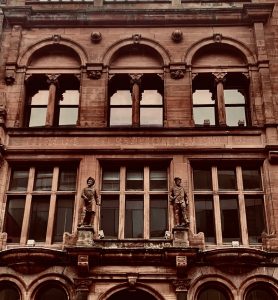


When raising a dram to bring in the bells at Hogmanay this year, spare a thought for the wonderful 1898 James Chalmers designed building at 64 Waterloo Street. The Ghost Sign found here for the Distillers Company Plc. leaves the trace of Wright & Greig Ltd. who were one of biggest whisky traders at the end of the 19th century.
The company started life as a small trader in Buchanan Street in 1868, before moving to West Campbell Street in 1876. The business grew rapidly in the license trade and before long they had to expand to bigger premises, moving once again to 8 Cadogan Street in 1888. Although their Cadogan Street premises, Cadogan Buildings, which sat on the corner of Wellington Street, was a large building with the company occuping 12,700 square feet and the rest of the building let as offices, Wright & Greig were keen to have their own purpose built premises to house their own cellars, blending and sample rooms, and their own offices.
By 1897, the company’s blended whisky, Roderick Dhu, and Shaugrun Irish Whiskey were both a big success, particularly Roderick Dhu, Old Highland Whisky, which garnered the higher profit of the two, due to it being exported globally. Therefore work began on the Waterloo Street premises on which we find the Ghost Sign for the Distillery Building.
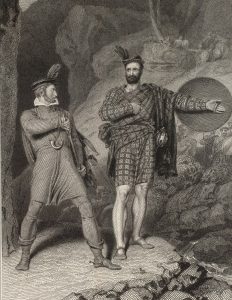
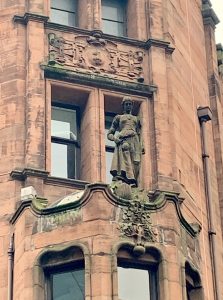
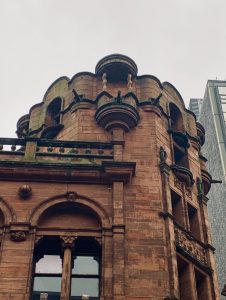
The now B-listed Waterloo Street building is adorned with a statue of Rhoderick Dhu over the door, a historical character lionised in Walter Scott’s famous poem ‘The Lady of the Lake’ published in 1810. Set in the Trossachs, the poem depicts the 16th century character Rhoderick Dhu of Clan Alpine, who led the rebellion of the Highland Clans in an uprising against King James. While over the oriel on the right corner of the building is a statue of a Highland Lass with her malting shovel. There are turret balconies with barley-sugar-columns, all sprouting miniature cannon, originally intended to be occupied by figures of the seasons. The building was designed and built to accommodate large cellars, blending and sample rooms, and offices. The building works cost £11,500 and was a great advertisement for their trade and most profitable product, Roderick Dhu whisky.
Wright & Greig later went on to acquire Dallasmore Distillery in Moray in 1899 which they renamed Dallas Dhu (the Distillery is now a museum under the stewardship of Historic Scotland). Unfortunately Wright & Greig’s booming trade didn’t last long. The company finally went into voluntary liquidation in 1919. However, bottles of Wright & Greig’s Special Blended Scotch Whisky, as well as Roderick Dhu, still continue to be produced and exported by Glen Ila Blending Company, and there is also a pub just across the road from the old Distillery Company building named after Rhoderick Dhu!
To receive all of our upcoming events and news before anyone else!
Please note that by signing up to this list, you consent to being contacted via email for updates on news and events by Glasgow City Heritage Trust, in accordance with our Privacy Policy. We value your privacy and will never send irrelevant information.