By Rachel Kacir

Posting on Instagram the day after the Union Street fire, artist Will Knight pointed out a small white dot on his monochrome drawing of the Knight map of Glasgow, commissioned by Glasgow City Heritage Trust (GCHT) in 2022. The dot marked the dome of the building which was engulfed and destroyed by the blaze. As Will states, “The mark on a drawing means little, but shows the building’s prominence in the city’s physical fabric, and therefore our collective conscious. The prominent corner was a place of meeting, arriving and departing. Fine buildings like this punctuate fine cities, and it’s no wonder words struggle to articulate their untimely, unsightly and unseemly loss.”
THE SULMAN MAP
For us at GCHT, this prompted a poignant realisation: like its Sulman predecessor, the Knight map was becoming a record of Glasgow’s lost buildings. Sulman’s Bird’s Eye View of Glasgow, released as a supplement to the Illustrated London News in 1864, captures Glasgow at a turning point in the industrial revolution. Looking north from the Southside of the Clyde, it depicts cargo laden ships packing the Clyde, its banks lined with cranes, warehouses and smoking chimney stacks. The streets are full of horses and carts, pedestrians and even a marching band – it’s a city on the move and on the up; growing and groaning with Victorian life.
THE KNIGHT MAP
The Knight map was conceived as a contemporary update to Sulman’s and is the same size, scale and perspective. Some areas, such as Glasgow Green and the Necropolis, are instantly recognisable, having changed little. The Britannia Music Hall, The Trades House and Hutcheson’s Hall are amongst the many buildings that still stand despite a century and a half of change. Another notable survivor is the Grant Arms, one of only two buildings remaining from the village of Grahamston, which vanished beneath the foundations of Glasgow Central Station when it was built in 1879. Urban fables of Victorian streets and shops, stuck in time beneath the maze of tunnels of Central Station are unfortunately just that, but the Grant Arms is no doubt a striking remnant. It benefited from a comprehensive repair scheme in 2020, with grant funding from GCHT enabling the facade to be repaired, re-harled and lime washed, and for the Glasgow Style timber work to be overhauled and the parapet renewed.

FROM HOT AIR BALLOON TO DRONE PHOTOGRAPHY
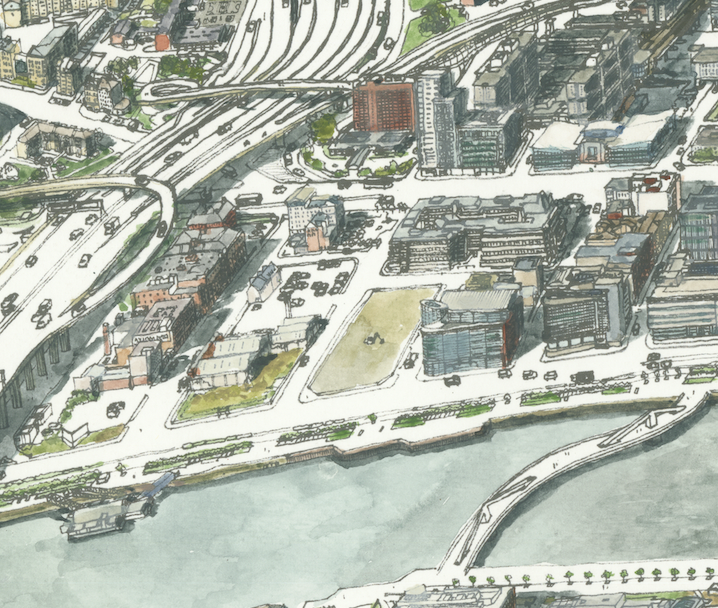
The story goes that Sulman took to a hot air balloon to draw his map, aided by photography and Ordnance Survey mapping. We couldn’t get a hot air balloon this time round (we did try), so instead we enlisted the help of John from Eye in the Sky Glasgow, who used drone photography to assist Will as he meticulously drew the city in 2022. The resulting artwork depicts the city mid digital revolution. High rise flats punctuate the skyline where the chimneys once stood. The Clyde lies dormant, with the motorway and railways cutting through the city as the main forms of transport for people and goods.
There’s several construction sites on the map, indeed even in the space of time it took to capture all the drone photography things changed, for example the new Barclays campus in Tradeston gradually takes shape in this time period. Just a couple of weeks ago, presenting to some Glasgow City Councillors in the City Chambers, I drew attention to a small detail: a digger on one of these sites. It may appear incidental, perhaps even a playful device to engage younger viewers. But it’s also always felt more than that too; a symbol of a city always in flux, always changing, evolving, transforming, whether we welcome the change or not.


LOST BUILDINGS
Until recently, that sense of transformation was largely framed by additions to the skyline. Now, 101-115 Union Street joins the unenviable list of lost buildings. On this list it sits alongside the India Buildings, constructed in 1876 as a warehouse for stationers Robert McGregor. A collapsed roof to this derelict building led to it being demolished in 2024. The loss of historic buildings is always felt deeply in Glasgow, and this was no exception. Franz Ferdinand frontman Alex Kapranos les tributes at the time, recalling his personal connection: “This is a great architectural loss to Glasgow. I have a particular connection to this building, as just behind it is where Franz Ferdinand put on our first events in an old factory we called The Chateau. We used to enter it via this building sometimes.”


THE DOME
The B-listed commercial building at 101-115 Union Street was built in 1851 by the architecture firm Brown and Carrick. John Carrick of the firm would go on to become Glasgow’s city architect, leading the pioneering City Improvement Trust in their slum clearance efforts, work which would make Glasgow a real pioneer for municipal improvements. The building therefore pre-dates Central station, which was built in 1879. However, that does mean it’s early enough to be featured on the Sulman map. Interestingly, the building is there, but the dome is not. Intrigued, we investigated further, and our patron John R. Hume’s walking guide, The Commercial Centre, confirmed that the dome was a later addition.

And there you have it. Even when you’ve studied it for years and think you know every detail, the Sulman map still has stories to tell, things to teach us about the city that was. We’re pretty sure the Knight map will do just the same for generations to come.
INTERESTED?
- Explore both the Sulman and Knight maps on our dedicated microsite
- Prints of both maps can be found in our online shop, or purchased directly from our office at 54 Bell St. Every purchase helps us protect, repair and celebrate Glasgow’s historic buildings and places.
- Alongside artist Will Knight we are still looking for a permanent home for the Knight map. For enquiries please contact us.
All drone shots by John S. B. Crawford, Eye in the Sky Glasgow.